Governance
Establishes authority, constraints, provenance, and the rules that must not be bypassed.
Declarative runtime-governance module
BGC — Behavior–Governance–Control — resolves approved behavior, governance, and control inputs into usable runtime state. It gives automation, AI-assisted operations, support systems, and platform controls a common way to determine what may happen, why, and under whose authority.
The system in context
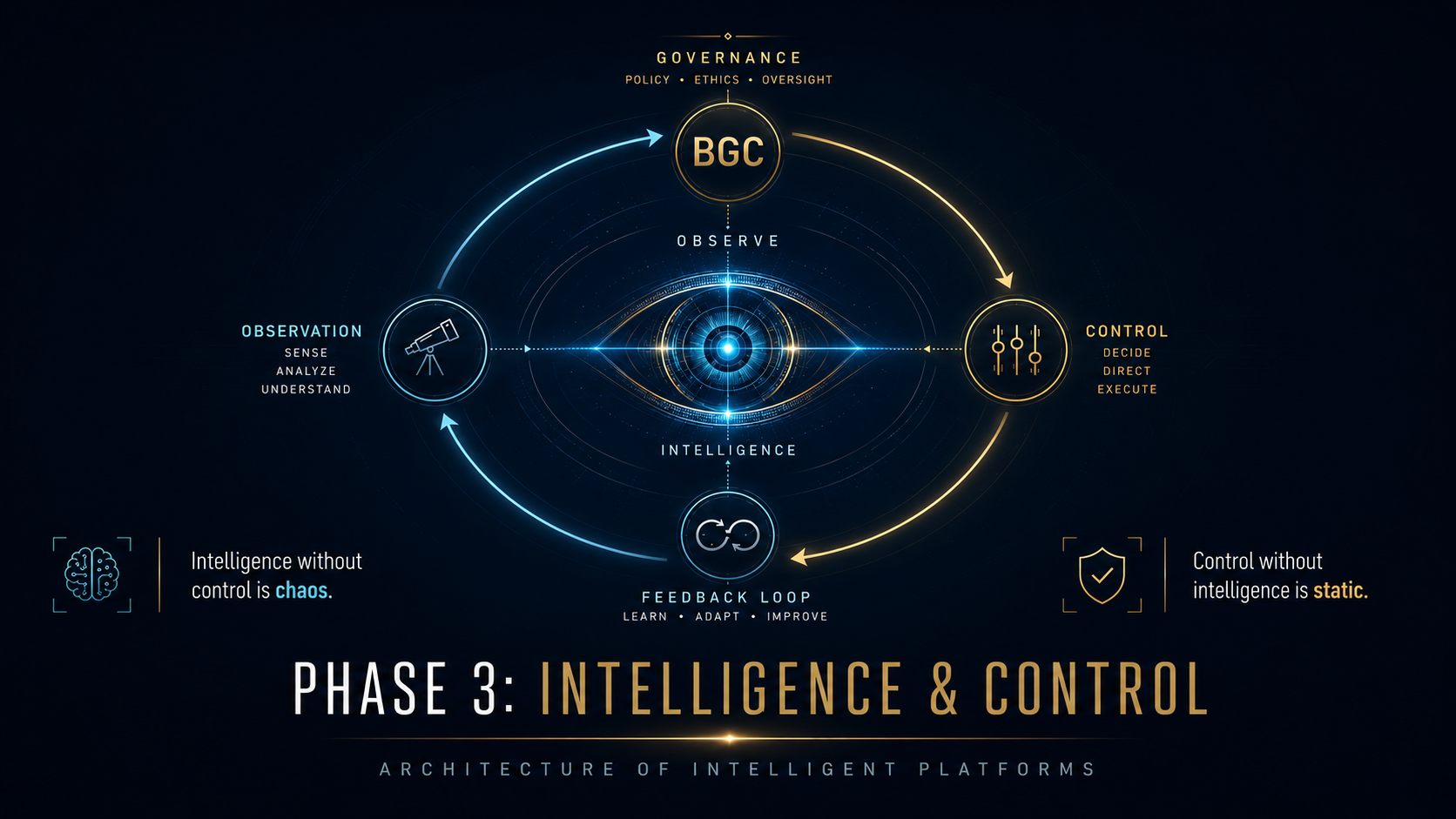
Declarative operating model
BGC is more than a configuration format. Runtime behavior is derived from governed inputs with explicit precedence, provenance, and validation.
Establishes authority, constraints, provenance, and the rules that must not be bypassed.
Exposes, limits, or disables capability within the authority that governance has established.
Defines the operating choices a governed component may select inside those limits.
Projects the validated result for consumers; it is derived state, not an alternate source of authority.
AI may advise, classify, or recommend inside an approved workflow. It does not automatically become governance authority, and not every internal BGC consumption path is represented as fully wired.
The connective operating layer
Each surrounding system keeps its own responsibility. BGC supplies a reusable way to evaluate rules, constrain action, record decisions, and expose evidence across those boundaries.
Approved response boundaries, role ownership, fact provenance, escalation, cost and latency evidence, and ITIL-linked service records.
The live support path is deterministic; unrestricted generative dialogue is not claimed.Standards as Implemented Service—pronounced “says”—turns written standards and policies into governed service behavior.
The flagship commercial and architectural expression of BGC.IGM provides governance and learning structure; BGC is its runtime execution arm for applied behavior controls and decision evidence.
IGM and BGC remain distinct—not synonyms.Parallel capabilityCost controlIGM includes cost-governance views; BGC provides the reusable runtime-boundary pattern that can constrain approved automation and model activity.
The direct IGM-cost-to-BGC enforcement linkage still requires confirmation.Defined integration gateITIL service operationsIncident, problem, change, request, ownership, evidence, recovery, and escalation can pass through explicit BGC behavior gates.
ITIL-aligned; no ITIL certification or tool accreditation is claimed.Database-backed rules, bounded enforcement, runtime projections, control flags, and decision history support repeatable operational control.
Current watcher state must be verified before any active-enforcement claim.BGC’s flagship concept
SAIS—Standards as Implemented Service—describes the move from policy that people must remember to service behavior that systems can evaluate, apply, and evidence.
BGC’s rule model carries framework and control references for standards packs including NIST, ITIL, ISO 27001, and SOC 2. TOGAF phase tagging and compliance views exist in the adjacent IGM namespace.
What it delivers
Deployment and commercial shape
Current evidence boundary
Confirmed as a full module with code and schema documentation. Existing watcher and metadata defects must remain visible rather than being hidden by a general maturity claim.
Portfolio publications
These are the existing Iberion and Meridian articles most directly related to this capability. They establish the portfolio’s published problem framing and architectural thesis; they are first-party publications, not independent certification.
Standards and external context
These official sources establish the surrounding disciplines. They do not certify BGC or independently verify Iberion implementation, performance, or qualification.
Continue exploring